Some labels describe safety testing. Others describe shipping, water protection or capacity. They answer different questions.
Inspect your battery label
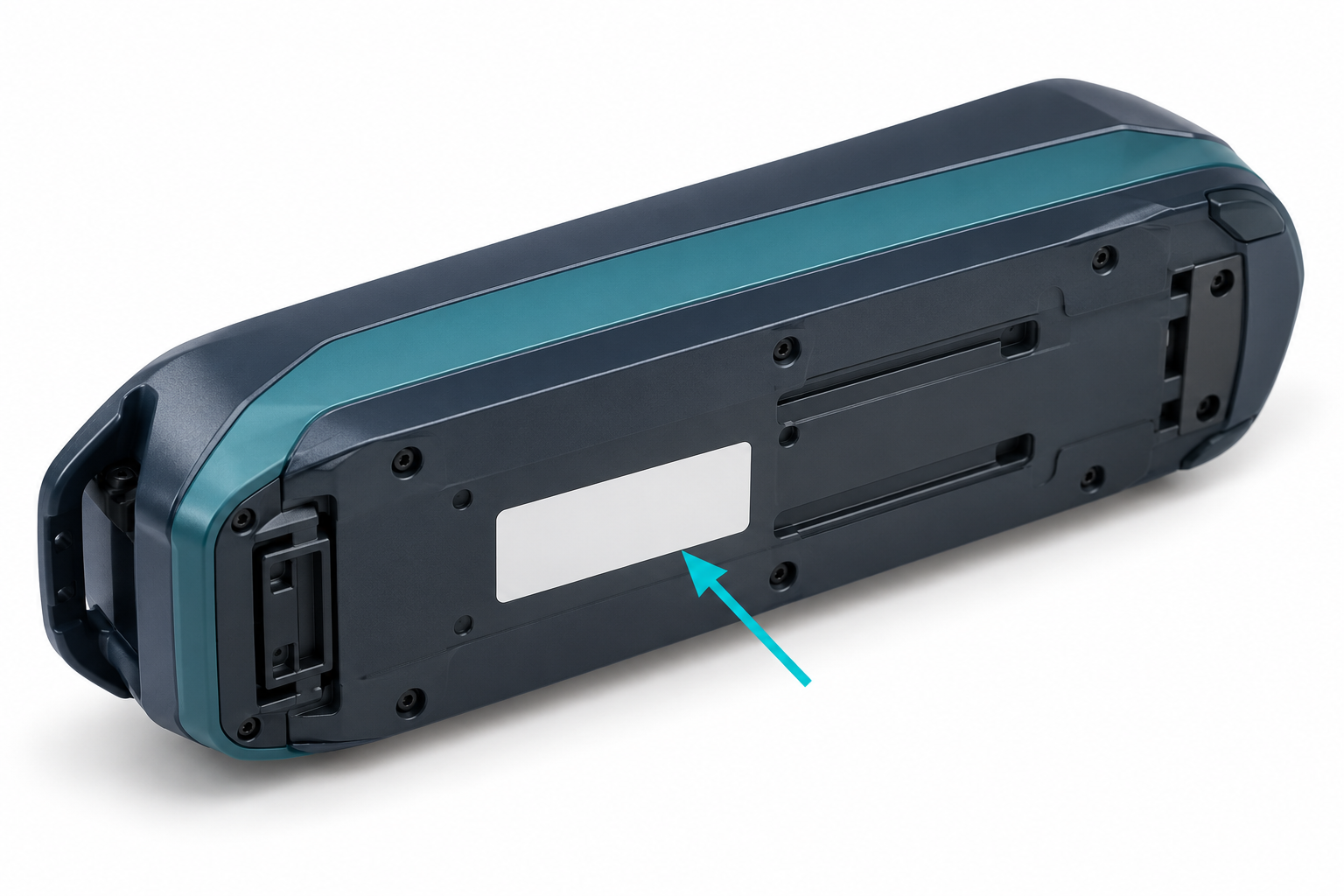
Example location. The label may be on the underside or side; check your model’s manual. Do not open the pack. Have a dealer check a built-in battery or a label you cannot safely reach.
Your photo stays on this device. Select or type its markings below; the picture is not automatically read or authenticated.
Start with these two UL standards.
UL numbers name safety standards. They are not a score: a bigger number does not mean a better battery.
BATTERY PACK
UL 2271
Safety requirements for batteries used in light electric vehicles, including e-bikes. Certification applies to the battery pack model listed.
It does not, by itself, certify the entire e-bike electrical system.
E-BIKE ELECTRICAL SYSTEM
UL 2849
Evaluates the electrical drive system, battery and charger combination for electrical and fire hazards.
It is not a rating for range, frame strength or overall riding performance.
Look on the product label. Check whether the certification covers the charger, battery pack or complete electrical system.
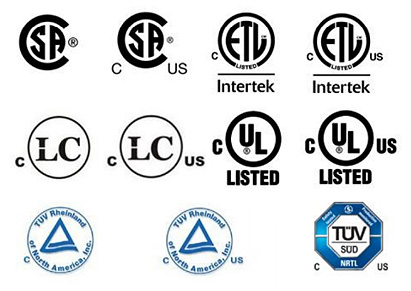
Health Canada’s reference sheet. Tap to enlarge. Marks are shown for identification only.
CSA — top left
CSA Group certification. Check the listing for the applicable standard and whether the mark covers Canada.
cETL — top right
Intertek certification for Canada; a combined Canada/U.S. mark is also shown.
cUL — second row, right
UL certification for Canada; a combined Canada/U.S. mark is also shown.
The mark names the certifier; the standard names the test requirements. For example, UL 2271 covers e-bike battery packs and UL 2849 covers the e-bike electrical system. A mark on the charger alone does not certify the battery or whole bike.
Image and charger guidance: Health Canada. EBIKE333 does not certify products.
Other marks you may see
UL, CSA and ETL — who certified it?
These are certification marks from different testing organizations. A product can be certified to a UL standard by another appropriately accredited organization, such as Intertek (ETL).
Check the standard number, exact model and scope in the certifier’s directory. A mark on the charger does not certify the battery or whole bike. For a charger used in Canada, Health Canada advises looking for a recognized Canadian mark such as CSA, cUL or cETL.
This standard covers electrical systems in devices such as e-scooters and hoverboards. It is not the e-bike electrical-system standard. For an e-bike, ask about UL 2849 and the exact system listed.
Tests lithium battery designs for transport conditions, such as vibration, shock and temperature changes. Ask the supplier for the test summary for the exact battery.
Passing transport tests does not establish certification to UL 2271 or UL 2849. It does not mean every courier or airline will accept the battery.
An IP code describes how an enclosure resists entry of solids and water under specified test conditions. The first digit covers solids; the second covers water. An “X” means that part of the rating is not specified.
IPX4 means protection against splashing water. IPX7 describes temporary immersion under defined test conditions. These are not fire-safety ratings or promises that a battery is waterproof in every situation.
Check whether the rating covers the battery, display or another part. Follow the bike maker’s cleaning instructions; do not pressure-wash the bike or deliberately submerge the battery.
CE means the manufacturer declares conformity with the applicable European requirements. It is not, on its own, proof of independent certification to a North American e-bike safety standard.
Ask for the model’s EU Declaration of Conformity and the standards it identifies. Do not treat CE as interchangeable with UL 2271 or UL 2849 certification.
EN 15194 addresses electrically power-assisted cycles. EN 50604-1 addresses lithium batteries for light electric vehicles. Their scope differs from UL 2849; do not assume the labels mean identical testing.
Ask which standard and edition were used, which exact product was evaluated, and whether the claim is supported by a test report or independent certification.
These numbers describe electrical characteristics. They are not safety certifications.
V — volts
The battery’s voltage. It must be compatible with the bike’s electrical system. A higher number does not automatically mean better quality.
Ah — amp-hours
Charge capacity. Compare Ah directly only when the batteries have the same nominal voltage.
Wh — watt-hours
Stored energy: approximately nominal volts × amp-hours. This is the more useful number for comparing battery energy capacity.
Example: 36 V × 14 Ah = 504 Wh. 48 V × 10.5 Ah = 504 Wh. Similar energy on paper, but not interchangeable batteries.
More Wh can provide more range under the same conditions. Hills, rider and cargo weight, weather, assist level and battery age all affect actual distance. A matching plug or Wh number does not confirm compatibility.
Find the maker, exact model, certification mark and listing or file number on the product label.
Look up that model in the certifier’s directory. Confirm whether the record covers the battery, charger or e-bike system.
Ask the seller for the listing if you cannot find it. “Tested to UL,” “UL cells” or a logo in an advert is not enough to confirm certification of the complete product.
Certification reduces risk; it does not make a damaged or mismatched battery safe. Use the manufacturer-approved battery and charger. Stop using and charging a swollen, damaged, leaking or unusually hot battery. For smoke or fire, move away and call emergency services. Never open the pack.
 Your E-bike Repair Site